REVIEW · SEOUL
Seoul: Learn Traditional Korean Strings Instrument & Hanbok
Book on GetYourGuide →Operated by TRIPPER · Bookable on GetYourGuide
A Korean instrument class in Hanbok sounds like a movie set. This one puts you in Bukchon Hanok Village for a hands-on Gayageum lesson, then sends you home with photos and a little keepsake. I like that it is beginner-friendly and still feels meaningful, and I like that you actually perform something familiar like Arirang after learning the basics. The main consideration: it is only 80 minutes, so you should expect a solid introduction, not true mastery.
You meet at 3F, 43 Bukchon-ro 5ga-gil, Jongno-gu, Seoul, and the class runs in English with a professional instructor. In the reviews, I kept seeing the same themes: patient teaching, clear steps, and a friendly vibe that helps first-timers get their hands moving. If you are camera-shy, the photo session may feel like a push, but it is also part of what makes the experience special.
In This Review
- Key Things You’ll Notice Right Away
- Bukchon Hanok Village and a Gayageum Class: A Clever Seoul Combo
- Your Instrument: What the Gayageum Lesson Actually Teaches
- Hanbok Rental: More Than a Costume Change
- Professional Photos in Hanbok While You Play
- A Realistic 80-Minute Flow (So You Know What to Expect)
- Price and Value: Does $106 Make Sense?
- What Makes the Teaching Style Work for Beginners
- Who Should Book This Seoul Experience
- Quick Practical Tips Before You Go
- Should You Book the Gayageum + Hanbok Class in Bukchon?
- FAQ
- How long is the Gayageum and Hanbok class?
- What instrument will I learn?
- Do I need any music experience?
- Will I play any specific songs?
- Is Hanbok included?
- Are professional photos included?
- Where do I meet for the class?
- Is the instruction in English?
- Can I cancel for a refund?
Key Things You’ll Notice Right Away
- Bukchon Hanok Village setting in one of Seoul’s most photogenic traditional neighborhoods
- Gayageum basics for beginners, taught with short, practical steps
- Hanbok rental included, worn for the whole class experience
- Professional photos taken while you play the instrument
- You perform a famous Korean song, such as Arirang, after the basics
- English instruction so you are not guessing along the way
Bukchon Hanok Village and a Gayageum Class: A Clever Seoul Combo
Seoul has plenty of cultural shows, but this is different because you are not just watching. You are learning a real instrument—then layering it with the look and feel of traditional Korea by wearing a Hanbok.
The setting matters. Bukchon Hanok Village is the kind of place where the streets already tell a story: old houses, narrow lanes, and that unmistakable traditional architecture. When you add a musician’s focus—fingers moving, strings tuned to your practice—it turns the neighborhood into more than a backdrop.
This is also a smart pairing for your trip. If you are already planning to walk Bukchon (or nearby Jongno-gu), this class gives you a reason to slow down and do something hands-on with what you are seeing.
You can also read our reviews of more tours and experiences in Seoul.



Your Instrument: What the Gayageum Lesson Actually Teaches
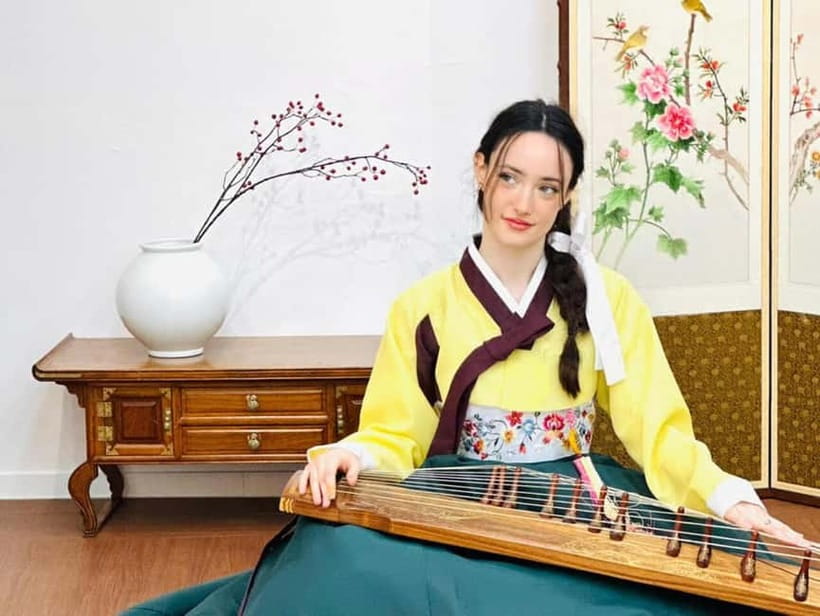
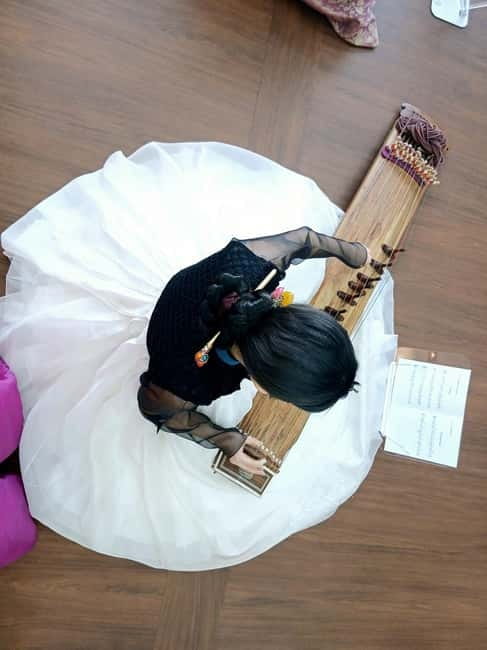
The star of the show is the Gayageum, a traditional Korean 12-string zither. You start with the fundamentals: how the instrument is set up, how your hands should position, and how to produce a clean sound without wrestling the instrument.
From the way the class is described, the teaching style is built for first-timers. You get a short intro to the instrument and its background, then you move into basic techniques in small, easy steps. One review notes that even if you are not sure about fit or comfort, you can get guidance on what works best—helpful if you are new to instruments and also new to Hanbok.
The payoff is performance. After you learn the basics, you are able to play a famous Korean song like Arirang. In one review, a participant ended up playing Amazing Grace by the end, which tells you the class is designed to get you to a satisfying moment, not just theory.
If your expectation is I will leave able to play at a concert level, you may feel slightly disappointed. If your expectation is I want to learn the core moves and walk away playing a real tune, this fits well.
Hanbok Rental: More Than a Costume Change
You wear a rented Hanbok for the duration of the class. That detail matters because it changes how you carry yourself and how you experience the setting.
Hanbok is not just for photos here. While you learn, you are also practicing in the culture’s visual language. That creates a stronger memory than simply changing clothes at the end, and it makes the instrument lesson feel more intentional.
A few reviews point out how pretty the Hanbok looks in person and how nicely it photographs. One review also mentioned help with choosing what fits you—so it is not a one-size-fits-all situation where you simply get handed something and figure it out.
Practical note: Hanbok can feel unfamiliar at first, especially if you are used to modern clothing. That is normal. The best strategy is to move calmly, listen to instructions, and focus on your hands and posture. The photos and the playing happen together, so comfort and guidance are part of the experience.
Professional Photos in Hanbok While You Play
This class includes professional photos taken while you play the Gayageum. That is one of the biggest reasons it feels like a full package instead of just a lesson.
In the reviews, people specifically liked that the photos turned out well even for those who do not consider themselves photogenic. That tells me the photographer and setup are doing real work: angles, timing, and getting you in the right position with the instrument.
The photo session is also timed for a reason. You are playing, not just posing. That means the images capture the activity you came for, not only the Hanbok.
If you hate being in front of a camera, you might want to mentally prepare for it. But if you like having something tangible from your trip—rather than only remembering it in your head—this is a solid value add.
A Realistic 80-Minute Flow (So You Know What to Expect)
With 80 minutes, the class has to be focused. You should expect a structured run: welcome, instrument introduction, technique practice, then group playing and/or individual practice, ending with the photos and keepsake.
Here is the rhythm you can reasonably expect based on how the teaching was described:
- A brief start with an intro to the instrument and its history
- Basic technique training in short, clear steps
- Guided practice, with the option to practice together or on your own
- A final shared performance moment
- Photos taken while you play
- A small takeaway, including a diploma in at least one case
One standout detail from reviews: the instruction is patient and flexible. That matters because Gayageum technique can be fiddly the first time you touch it. When your teacher stays calm and explains in a way you can follow, you stop feeling behind and start making progress.
Also, the instructor language is English, which reduces the stress of trying to decode directions mid-strum. Names from reviews include Ava and Yoo Min / Yu Min, and all were praised for kindness and patience.






Price and Value: Does $106 Make Sense?
At $106 per person for 80 minutes, you are paying for more than a music class. You are paying for:
- a professional instructor
- a real hands-on Gayageum lesson
- Hanbok rental for the class duration
- professional photos
- access to Bukchon Hanok Village’s iconic atmosphere
If you compare it to the cost of renting Hanbok on your own plus hiring someone to take photos, this starts to look more reasonable. The lesson component is what keeps the experience from being only a fashion moment. You get an activity that actually builds a skill, even if it is a beginner level one.
The value sweet spot is this: you get culture in your hands, not just on a schedule. And you leave with media you can share, plus a keepsake that makes it feel official.
The one place it may not feel worth it is if you dislike structured group settings or you only want free-form sightseeing. This is a class, with a set format, a teacher-led flow, and a photo session.
What Makes the Teaching Style Work for Beginners
A lot of cultural classes say beginner-friendly. This one seems to back it up with pacing and patience.
Reviews describe the teacher as kind, enthusiastic, and very patient with first attempts. That matters because your first sound on a new instrument can be awkward, and you may need corrections for hand position. When the instructor explains in small steps, you can keep your confidence while you learn.
One review also highlighted flexibility: after learning techniques, you could practice on your own or together depending on what felt comfortable. That gives you a little control over how fast you want to feel comfortable.
The English instruction is also a real advantage. You are not stuck with a language barrier while learning a technique that relies on physical cues. That combination—English + patience + step-by-step—helps you get results within a short class window.
Who Should Book This Seoul Experience
This class is a great fit if you want:
- a hands-on introduction to traditional Korean music
- an activity that combines walking a historic neighborhood with doing something inside
- a cultural souvenir package: Hanbok + pro photos
- a beginner-level lesson that ends with a recognizable performance moment
It is also a good choice for couples, friends, or solo travelers who like structured activities. If you are the type who enjoys learning something you can repeat later, you may end up wanting to practice at home after you see how quickly the basics become doable.
If you are a serious musician looking for advanced training, you may find the class too short. Think of it as an entry point, not a conservatory course.
Quick Practical Tips Before You Go
- Wear comfortable shoes nearby. You do not want your feet exhausted before you step into a sitting instrument lesson.
- Bring a calm mindset about photos. You are there to play, but the photos are part of the schedule.
- If you are sensitive to clothing fit, let the instructor know right away. One review mentioned getting advice on what pairs better.
- Consider pairing this with a Bukchon walk before or after, so you can connect the instrument lesson with the neighborhood vibe.
Should You Book the Gayageum + Hanbok Class in Bukchon?
I think you should book it if you want a Seoul activity that feels personal and memorable. You get a real skill (Gayageum basics), you get the full traditional look (Hanbok rental), and you get professional photos that capture the moment while you play. At $106 for 80 minutes, the package is priced like a curated cultural experience, but it does include enough extras to justify the cost.
Skip it if you strongly dislike being photographed or if you expect long, advanced instruction. It is short by design, and it is meant to get first-timers to a satisfying performance, not to train you into a lifelong craft in one session.
If that sounds like your style, this is a very strong Seoul choice.
FAQ
How long is the Gayageum and Hanbok class?
The class lasts 80 minutes.
What instrument will I learn?
You will learn the Gayageum, a traditional Korean 12-string string instrument.
Do I need any music experience?
No musical experience is required. The class is designed for absolute beginners as well as music lovers.
Will I play any specific songs?
After learning the basics, you will perform a famous Korean song like Arirang.
Is Hanbok included?
Yes. Hanbok rental is included for the duration of the class.
Are professional photos included?
Yes. Professional photos are taken while you are playing the Gayageum.
Where do I meet for the class?
The meeting point is 3F, 43 Bukchon-ro 5ga-gil, Jongno-gu, Seoul.
Is the instruction in English?
Yes. The instructor provides instruction in English.
Can I cancel for a refund?
Yes. You can cancel up to 24 hours in advance for a full refund.